


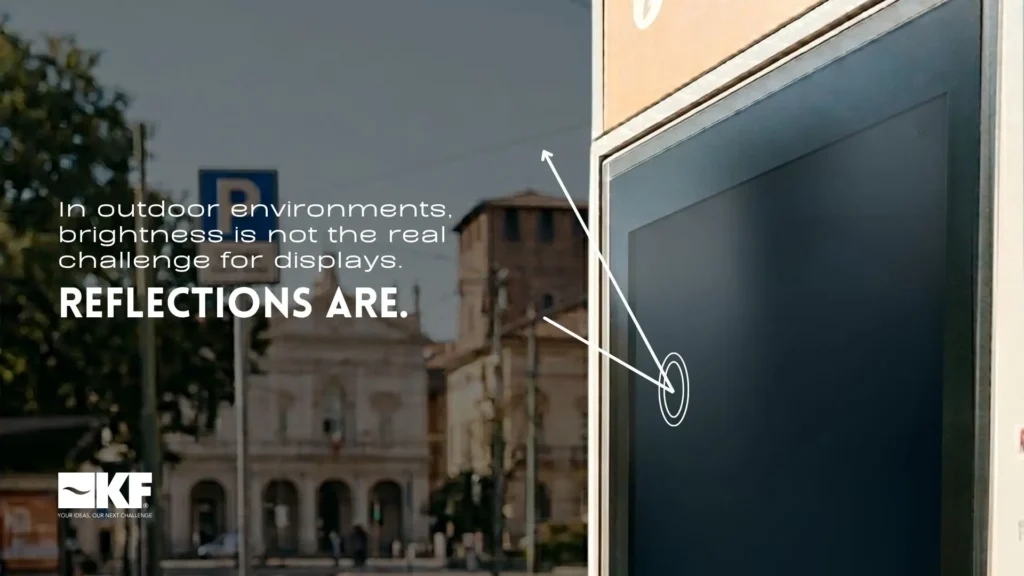
Anti-Glare: When Display Readability Meets Real-World Conditions
When Light Becomes Part of the Challenge
Direct sunlight, reflections and poor viewing angles can turn a fully functional display into an unreadable interface in just a few seconds.
For industrial displays used in outdoor and semi-outdoor environments, readability cannot depend on ideal lighting conditions. Ticketing machines, self-service systems and outdoor kiosks must remain usable even when the surrounding light changes significantly.
This is where Anti-Glare technology comes into play.
Controlling Reflections, Not Blocking Light
Anti-Glare is a surface treatment applied to the glass that changes the way light interacts with the display.
Instead of producing a mirror-like reflection, the treatment diffuses incoming light across microscopic surface structures, significantly reducing glare.
The principle is simple:
You do not block the light. You control the reflections.
This distinction is important because simply increasing display brightness is not always the answer. In certain conditions, higher brightness can even amplify reflections and make the display harder to read.
Anti-Glare addresses the problem at its source by managing how ambient light is reflected from the display surface.
From Optical Treatment to Better Usability
The benefits become particularly relevant in applications where users interact directly with the display in changing environmental conditions.
By reducing reflections, Anti-Glare can contribute to:
- improved readability in bright environments;
- more stable visual performance under outdoor lighting conditions;
- reduced visual fatigue for the user;
- more consistent usability across different environments.
The result is a display that is better prepared to deal with the conditions in which it will actually be used.
A Design Choice Within the Complete System
At KF, Anti-Glare is not considered simply an optical option to be added to a display.
It is part of an engineering approach in which different technologies work together to achieve the required performance.
Depending on the application, Anti-Glare can be combined with high-brightness displays and intelligent ambient light management, creating a system designed to respond dynamically to its surroundings.
Because outdoor environments cannot always be controlled.
The display can be.
And engineering that response is what makes the difference between a display that simply works and one that remains readable when real-world conditions become challenging.